Multi-agent setup: presets, memory graph, web search
What this doc solves
Luker's multi-agent orchestrator, memory graph, and search tools each work standalone — but getting them to collaborate as one flow (an agent team that extracts memories, looks up canon, drafts the prose) takes a few configuration steps in order.
This doc starts from an empty configuration and walks you through preset → director → memory → search end-to-end. It does not assume you have read the three deep-dive docs above. By the end you have a working default setup that you can keep tuning in the iteration studio.
What you'll get
After you finish this doc, when you send a message in the main chat, the main LLM doesn't start writing immediately — an agent team runs first:
memory_scoutsweeps the memory graph and pulls characters / events / locations relevant to the current beatcanon_scout(when needed) looks up fandom canon on the webplot_brainstormerdrafts a few structural sketches from different angles in parallel; the main agent picks one- Main agent takes the scouts' output and writes the final body directly
memory_curatorwrites new facts back to the memory graph after the draft is done
The memory graph's Auto extraction / Auto compaction are entirely handed off to the agents, and the search provider defaults to DuckDuckGo — no API key, no embeddings, no extra LLM routing needed.
How the team divides up

The memory graph's own "Auto extraction / Auto compaction" no longer fires — the agent is doing the same job. Once a search provider is enabled, canon_scout is able to look things up; otherwise it returns zero results.
What you need first
- A working Luker instance where the main chat already produces replies
- A working RP preset, ideally already tuned with style guidance, jailbreak, and NSFW direction
Step 1 — Pick a starting preset
Any RP preset you'd normally use is fine. This step just confirms you have a writing preset to start from — the next step builds the two preset variants Director needs from it.
Step 2 — Configure the Preset Assistant and derive the two presets Director needs
LLM calls made by Luker's plugins fall into two broad categories with very different preset needs. One is plugins producing RP content — Director's agent team drafting the body, critic sub-agents reviewing, and so on — which wants a real RP preset with jailbreak / style / anti-cliché guidance. The other is the iteration AI that powers various plugins — the Preset Assistant, the Memory Graph schema studio, CardApp Studio, Director's Iteration Studio, and so on — which uses tool calls to edit configs or extract structured data; any RP instructions leaking in will interfere with the model executing the plugin's instructions, so these slots want a stripped-down preset with only jailbreak left.
Director's flow touches both categories at once:
| Path | Who uses it | Preset shape |
|---|---|---|
| Agent path — main agent + sub-agents producing the body | The actual drafters; their output ends up in the chat | A standard RP preset, tuned for tool calling: keeps jailbreak + style + anti-cliché, but drops placeholders / hard schemas that fight the orchestrator |
| Iteration Studio path — the AI you talk to inside the studio when tuning your config | A tool-using config editor; never writes story prose | A stripped-down preset with only jailbreak left — no style guidance, no NSFW writing rules, no narrative meta-rules |
Why not just one preset for both?
RP presets assume "one LLM writes the whole reply by itself." Drop those instructions into an agent tool loop and they:
- Fight for airtime against the agent's system prompt
- Cram "must output schema" / "mandatory chain of thought" constraints into the drafting step, breaking tool calling
- Re-inject placeholders (character description, persona, world info entries) the orchestrator's main path already injects
The Iteration Studio is even more sensitive — it doesn't write story prose at all, it edits a JSON config via tool calls. Any RP instruction that leaks in interferes with the model executing the plugin's instructions.
2a — Configure the Preset Assistant itself
The Preset Assistant is the tool we'll use in 2b to derive the agent preset, but it's an LLM-driven tool itself — it needs its own iteration AI preset and API profile before you can open it.
Open the Extensions drawer (#extensions_settings2 — the same drawer that holds the Orchestrator, Memory, and Search Tools panels). Find the Completion Preset Assistant panel and fill in:
- Iteration AI prompt preset (params + prompt) — click the ? button next to this field
- Iteration AI API preset (Connection profile) — pick any working API profile
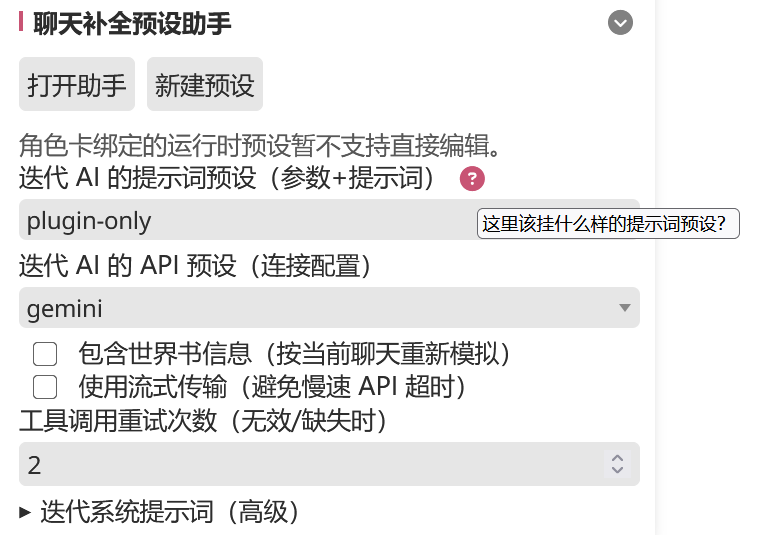
The ? button opens an explainer popup with an Import plugin-only preset button at the bottom — one click imports Luker's bundled clean preset and auto-selects it here.
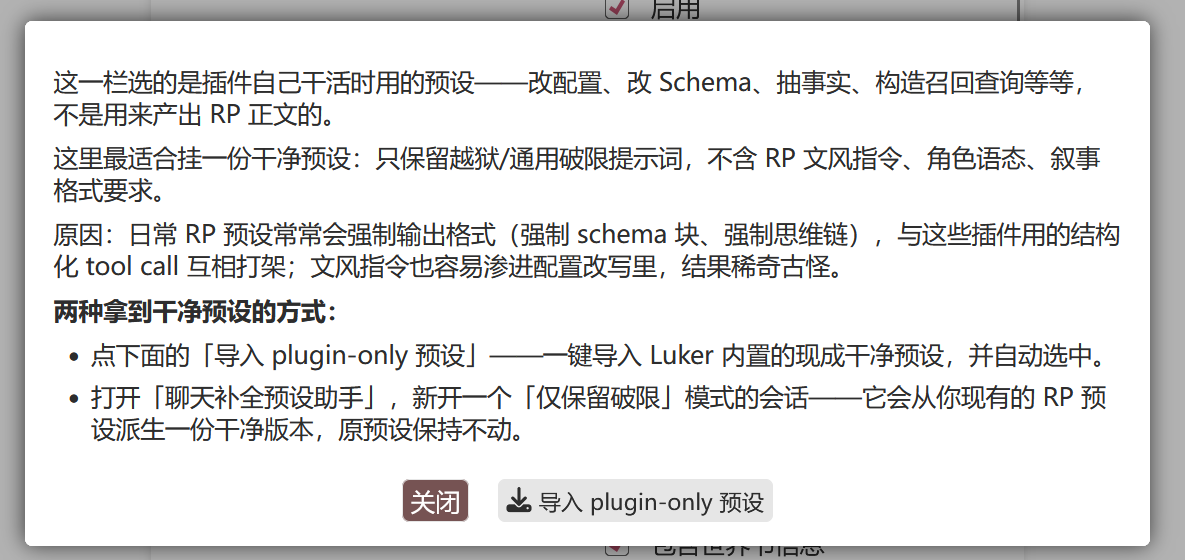
Other Luker plugins with their own iteration AI (Director's Iteration Studio, Memory Graph schema studio, CardApp Studio, etc.) expose the same ? button next to their preset selector — the same one-click import works there too.
2b — Derive the agent preset
Now that the Preset Assistant is configured, click Open Assistant in the same panel. In the popup, set the Edit mode dropdown to Adapt for orchestrator, then tell it:
Convert this preset into an agent-only preset
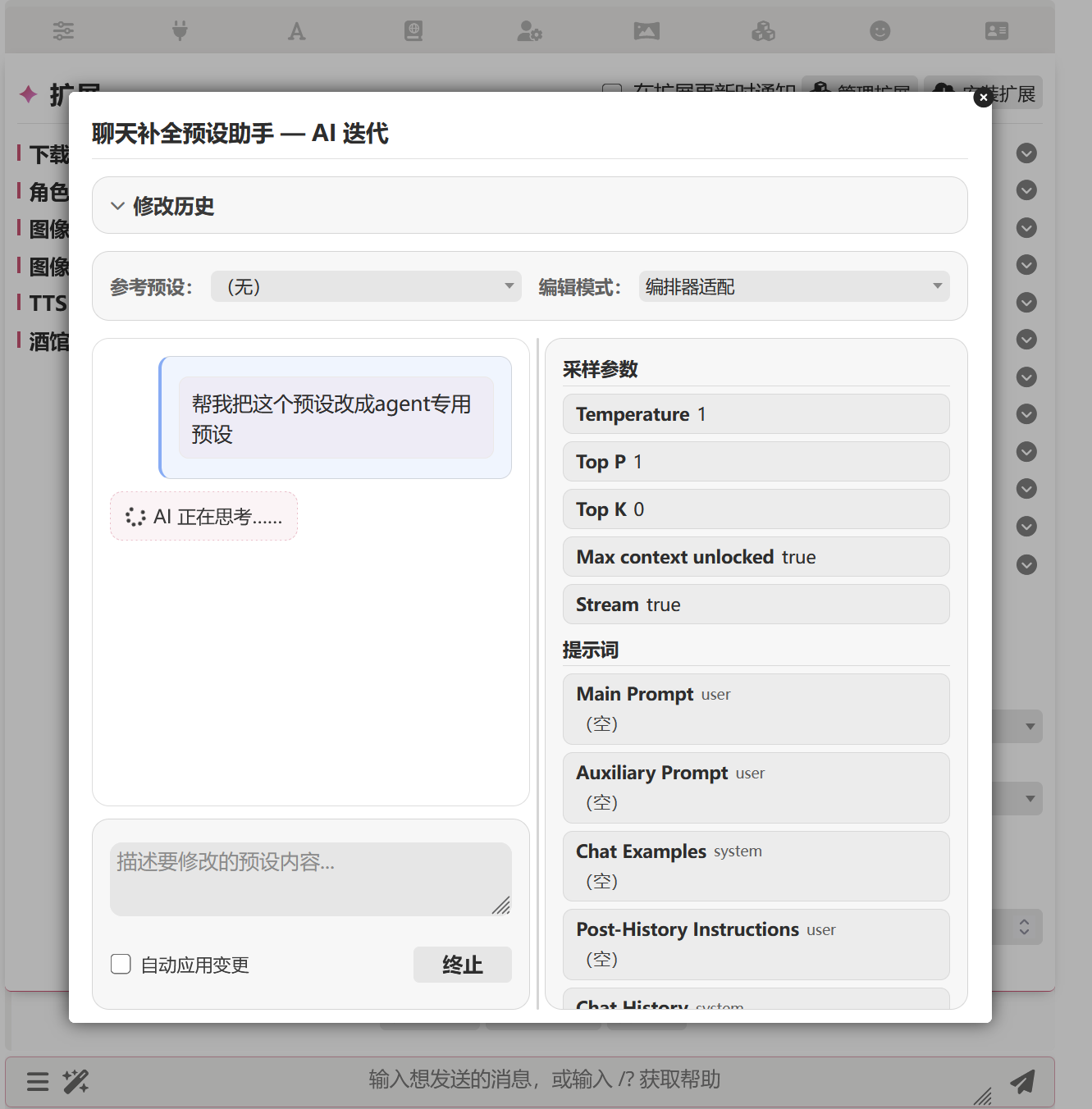
By default it will derive a new preset (original name + -orchestrator suffix) — the original stays as-is. It automatically:
- Disables placeholders that would be double-injected alongside the orchestrator's main path: character description, persona, example messages, explicit world info
- Rewrites format constraints that would interfere with tool calling (forced schema, fixed CoT headers) from hard requirements into soft hints
- Gates instructions that only matter for the final draft (summaries, style sign-off) to the "final commit message" phase
- Keeps chat history, style guidance, and jailbreak / anti-cliché instructions — the main agent reads them while drafting, and the critic sub-agents read them while reviewing
Walk through its diff, approve each entry.
While you're here, let it tune the preset further
Adapt for orchestrator is just one of the assistant's three Editing modes. Switch the toolbar's Editing mode back to the default General editing, start a new session, and the same assistant becomes a general-purpose preset editor — useful for things like "add an anti-cliché directive backed by a few negative examples", "tone the prose-style guidance down from purple to restrained close-detail", or "merge these three rules that say the same thing". See Preset Assistant for the full picture.
The Adapt-for-orchestrator pass also proactively sweeps for reusable style / format / writing-discipline rules buried in your preset entries and proposes lifting them into shareable skills (verbatim, at this preset's scope, with a pointer left in the original entry). Each is reviewable independently — approve, reject, or ignore the proposals and the rest of the adapt still applies. See Authoring skills from preset content for the why and the safeguards (one-off tweaks never trigger the sweep).
Step 3 — Switch to Director mode and wire up the two presets
Open the Multi-Agent Orchestration panel in the Extensions drawer:
- Set Execution mode to Director (multi-agent)
- Set the API preset + Chat completion preset to the
-orchestratorpreset from Step 2b - Find the AI Iteration Studio section and set its API preset + Chat completion preset to the plugin-only preset already imported in Step 2a
Step 4 — Hand memory extraction and recall over to the agents
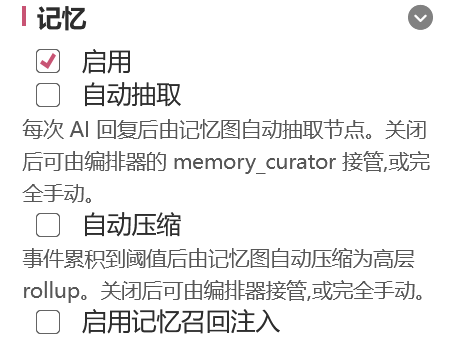
Open the Memory panel in the Extensions drawer:
- Enable ✓ keep on
- Auto extraction ✗ turn off (the curator sub-agent takes over)
- Auto compaction ✗ turn off (same — the agent handles it during housekeeping)
- Enable memory recall injection ✗ turn off (a scout sub-agent already runs an LLM-level recall pass before drafting; leaving the built-in injector on would double up and pollute the main agent's context)
Prefer the memory graph's built-in extraction, recall, and compaction?
The default Director config claims extraction / recall / compaction for itself. If you trust the memory graph's own pipeline more (already tuned with multi-model routing, Hybrid + Rerank, etc.):
- Re-enable Auto extraction, Auto compaction, and Enable memory recall injection
- In the iteration studio (Step 6), tell the studio AI: "I want to manage memory myself with the built-in memory graph; the agents shouldn't touch it."
- The studio AI will modify your orchestrator config via tool calls — review entry by entry and save.
Step 5 — Pick a search engine
Open the Search Tools panel in the Extensions drawer. Search provider defaults to DuckDuckGo (no login) — leave it. If you want something more refined, switch to SearXNG (custom instance) (fill in your self-hosted URL) or Brave Search (API key).
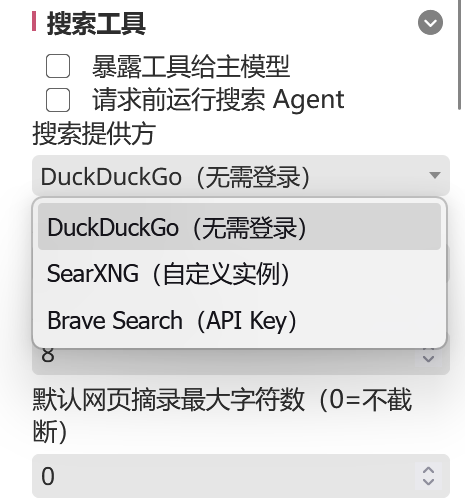
How the two top toggles relate to this flow
Expose tools to main model and Run pre-request search agent are the search tool's two independent working modes, unrelated to Director — this flow uses Director's own search sub-agent, and neither of those toggles needs to be on.
If you're not running Director and still want search, see the search tool's two working modes instead.
Step 6 — Want to change something? Open the iteration studio
After switching to Director, click Open AI Iteration Studio in the orchestrator panel — that's the entry point for all further customization.
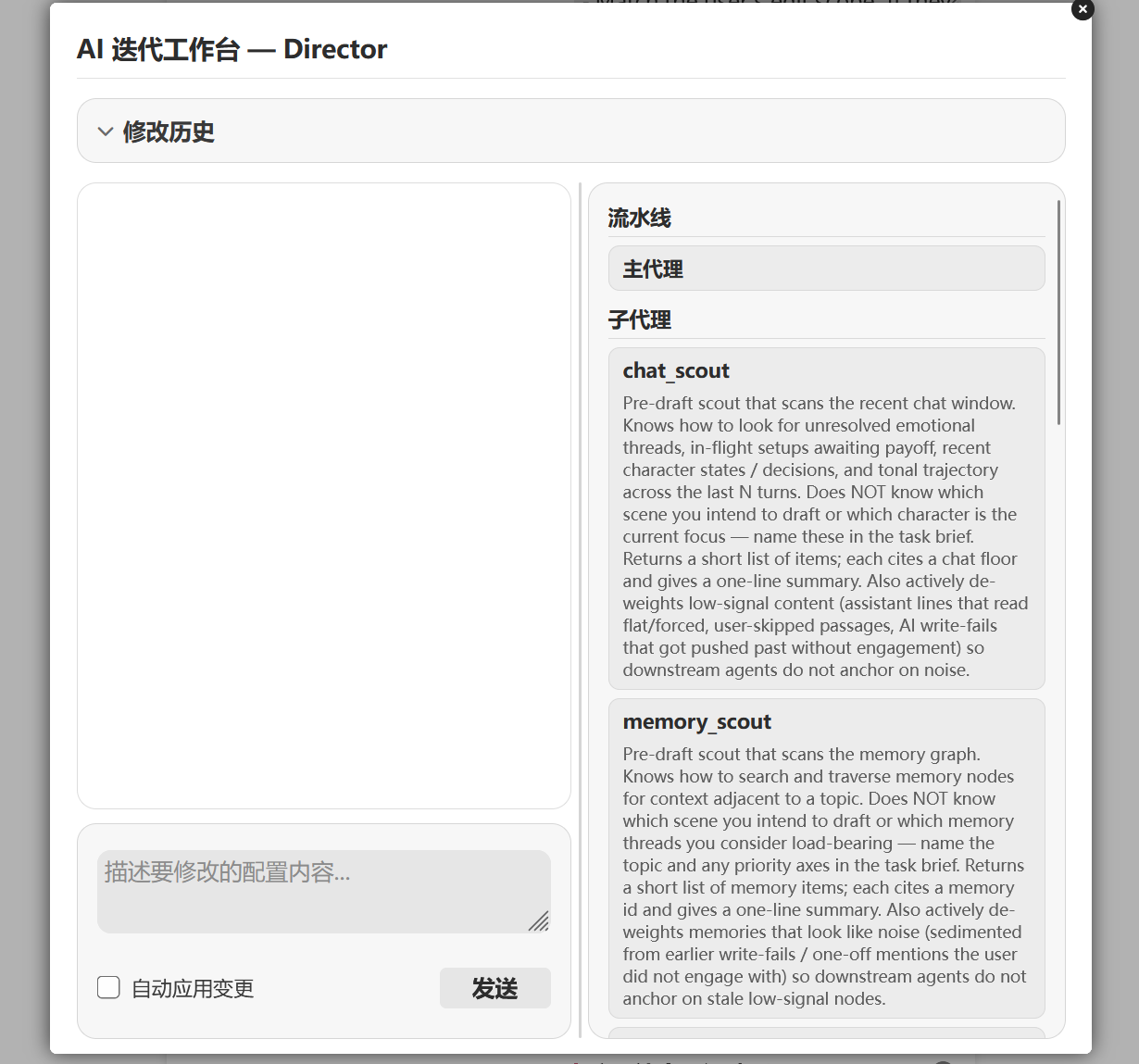
When you open the studio determines what config it edits:
- No character chat open → the studio edits the global default config — all cards without overrides pick this up
- A character chat is open → the studio edits this card's override — only this card is affected, and the override travels with the card on export / import
A great per-card profile can be promoted to global
If you iterate a Director profile that turns out great for a specific card, you can promote it manually: export that card's profile from the orchestrator panel, clear the current chat to return to a no-card state, then import that profile to global. Same applies to schemas.
Global scope — things you can say
- "I don't want agents managing memory. Remove the ones doing extraction and recall."
- "I don't want agents searching for canon online. Remove the search sub-agent."
- "Read the image-generation guidance from world info, then add a sub-agent that — after the body is drafted — figures out where to insert illustrations and what prompts to use."
- "Read the variable-update guidance from world info, then add a sub-agent that — after the body is drafted — figures out how variables should update."
Per-card scope — things you can say
- "Tailor the main agent prompt to this card's setting and current plot — give it a specific writing discipline."
- "This card has custom stamina / mood variables. When the memory curator extracts, prioritize filling those fields."
- Anything specific to this card's genre that doesn't belong in the global config.
The studio walks you through a diff entry by entry — approve and save. If you go off the rails, reset to the default Director config.
Step 7 (optional) — Let AI iterate your schema
The memory graph schema is also iteratable by AI. In the Memory panel, click AI Iterate Schema to open the Memory Graph Schema Studio.
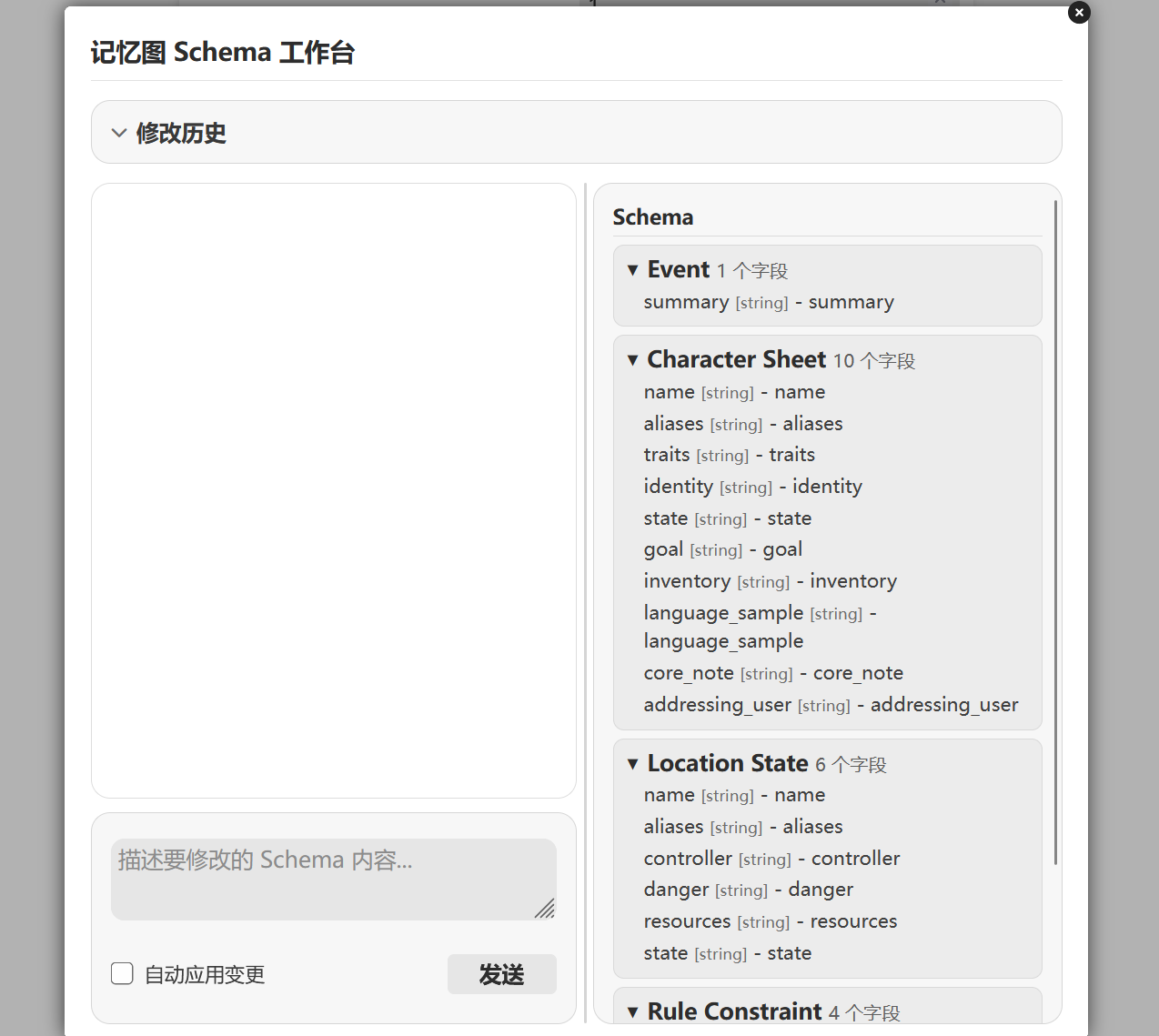
Like orchestration configs, schemas have both global and per-card scope — per-card schemas travel with the card on export. You can use the studio to tailor the schema for a genre, for example:
- Xianxia / cultivation: add
cultivation_realm,spirit_meridianfields to characters - Political intrigue: add a
factionnode type, tracking alliances and enmities - Survival: add
inventory_itemnodes, tracking each item's durability and state
Don't forget the memory graph's iteration AI preset
The Schema Iteration Prompt (schema-editor AI) field in the Memory panel feeds into the same "iteration AI path" mentioned in Step 2a — its preset selector also has a ? button; if you already imported plugin-only in Step 2a, just pick it from the dropdown here.
Go play
Send a message in the main chat. Expand the reasoning fold and you'll see the agent team working live:
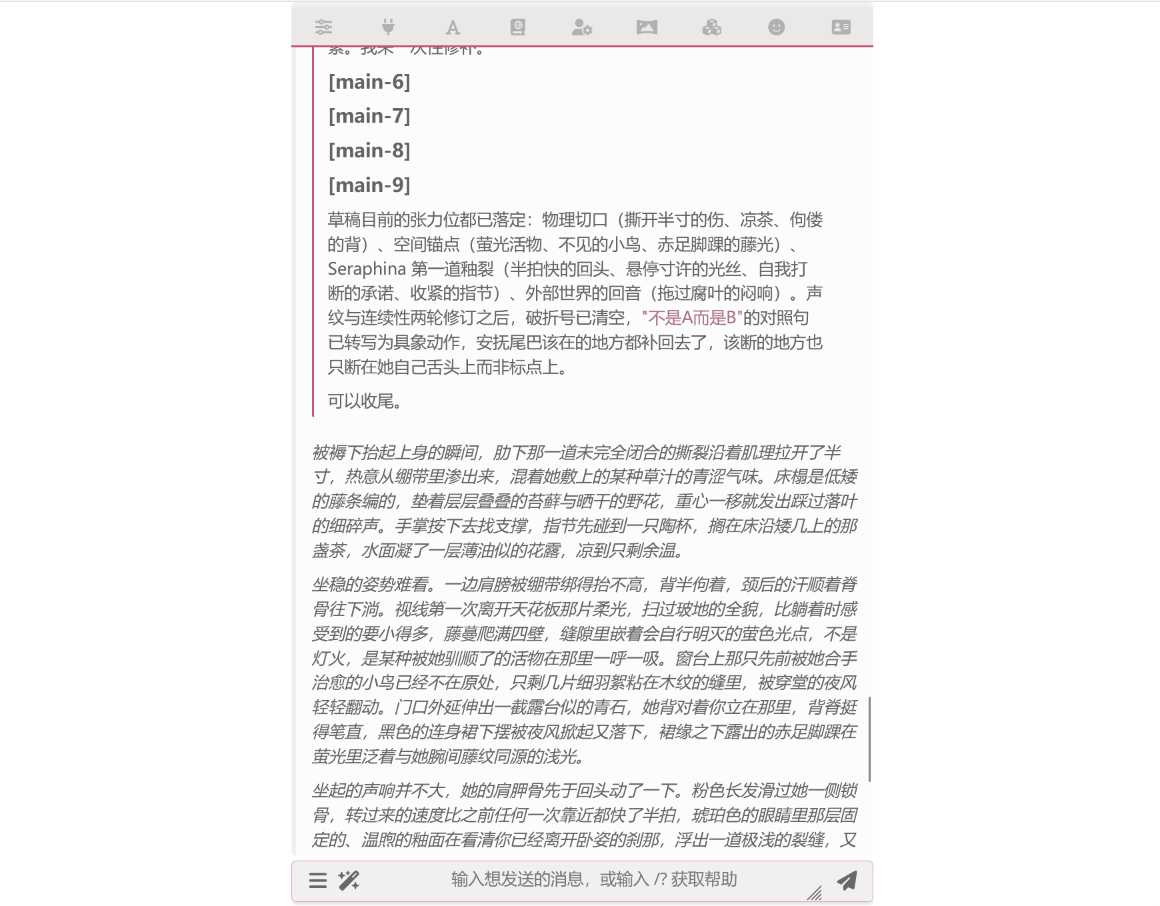
- Pre-draft scouts: each surfaces ~5
Item / Source / Whyitems — characters, events, world info entries that matter to the current beat - Mid-stage brainstorming: a few structural sketches in parallel from different angles for the main agent to pick from
- Post-draft critics: sub-agents push back on the main agent's draft; the main agent decides which critiques to accept
- Housekeeping: writes the turn's new facts back to the memory graph
Want a deeper look — each agent's actual reasoning, every tool call's request and response? Open the Run Panel beside the chat (or the bottom drawer on narrow screens) and expand any round.
Not happy? That reasoning fold is the full agent execution log — pinpoint where things went off, then head back to the AI Iteration Studio and describe in natural language what you want changed.
Where to go next
- Multi-Agent Orchestrator overview — triggering, capsule injection, the four execution modes
- Director mode — the 12 default sub-agents and their roles
- AI Iteration Studio — natural-language tuning of your config
- Memory Graph — node types, recall algorithms, schema customization
- Search Tools — engine differences + the standalone working modes
- Preset Assistant — the other two session modes beyond "Adapt for orchestrator"